
Report date: 15 November 2026
No policy change announced
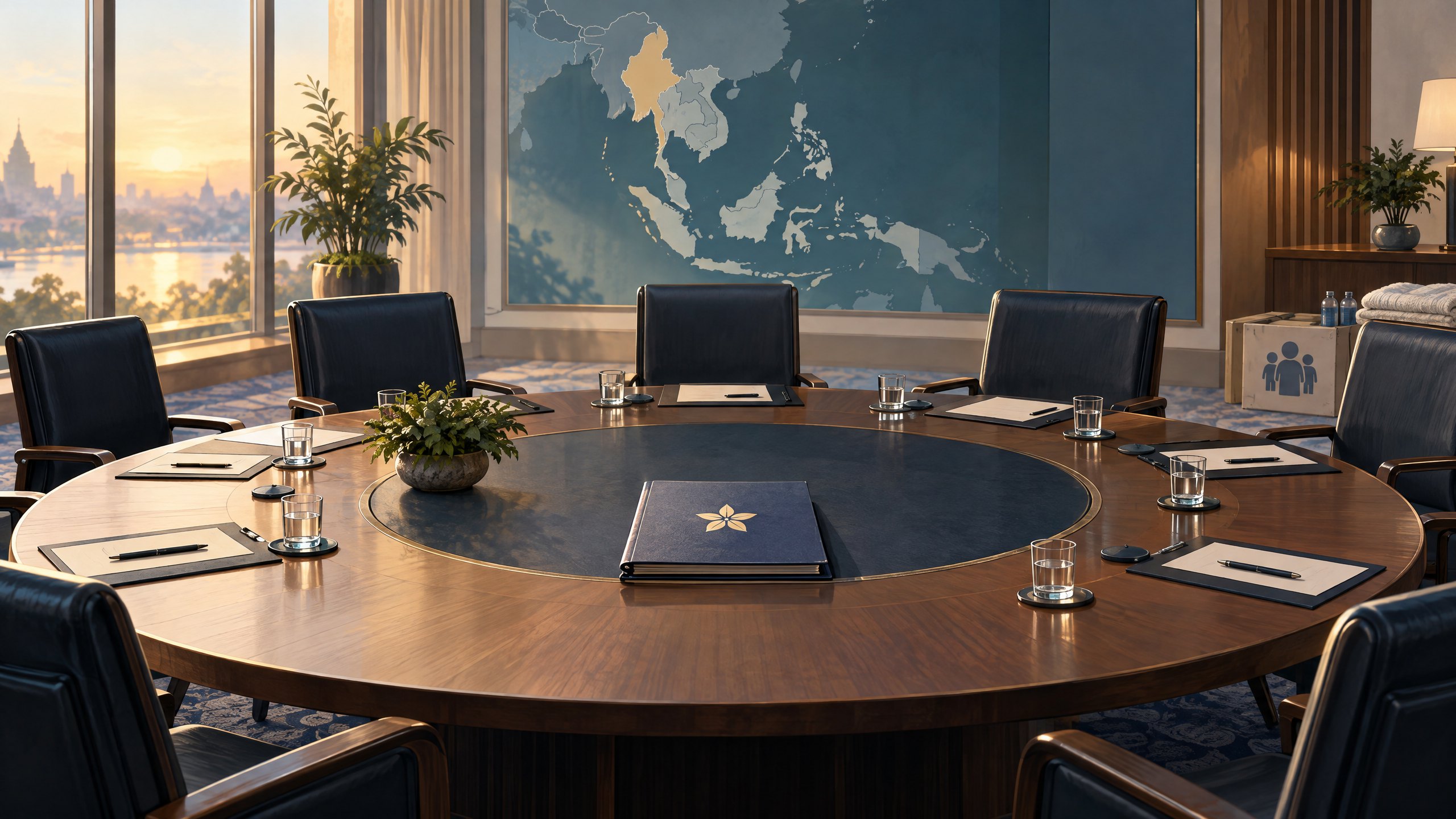
As ASEAN leaders begin their Manila summit on November 15, the bloc’s Myanmar envoy says there will be no easing of its approach to the crisis. Philippine Foreign Secretary Ma. Theresa Lazaro, who is also this year’s ASEAN chair’s special envoy, said the Five-Point Consensus remains in place. A draft review is still being negotiated, and the leaders are expected to consider the foreign ministers’ recommendations during the November 15–17 meetings. Reuters BusinessMirror
This does not mean Myanmar has been removed from ASEAN. Myanmar remains a member state. Since 2021, however, its military-led authorities have not been represented by their top political leaders at ASEAN summits and foreign-minister meetings. Myanmar has instead been represented by a non-political official. The change followed the military coup and ASEAN’s concern about the lack of progress on its peace plan. Singapore Ministry of Foreign Affairs The Independent
What the Five-Point Consensus asks for
ASEAN leaders agreed the Five-Point Consensus in April 2021 after the coup. It calls for an immediate end to violence and restraint by all sides; dialogue among all parties; an ASEAN chair’s special envoy to facilitate mediation; humanitarian assistance through ASEAN’s AHA Centre; and visits by the envoy to meet all parties. It is a diplomatic framework, not a ceasefire already achieved. ASEAN’s 2021 statement

The gap between the plan and events remains central. In its 2025 review, ASEAN said there had been no substantive progress and expressed deep concern about conflict and the humanitarian situation. The bloc urged parties to halt indiscriminate violence, protect civilians and allow humanitarian assistance. ASEAN leaders’ 2025 review
The proposal still on the table
The immediate debate is not simply whether to invite Myanmar’s top leader back to the summit. Thailand has proposed allowing Myanmar’s foreign minister to participate in ASEAN foreign-minister meetings. Lazaro said the idea remains under discussion, but no decision has been made to give the minister Myanmar’s seat. Myanmar’s foreign minister attended an informal ASEAN consultation in Bangkok in July, but that meeting did not itself change the bloc’s standing policy. BusinessMirror Reuters on the wider debate IISS analysis
Some ASEAN members have pursued more direct bilateral contact with Myanmar’s military-backed authorities. Reuters reports that Thailand and several other members have hosted Min Aung Hlaing this year, while Thailand argues that talking with officials can help address cross-border issues and convey ASEAN’s concerns. Other voices warn that restoring political access without measurable progress could weaken the bloc’s leverage. These national contacts are not the same as a collective ASEAN decision to change representation rules. Reuters
The disagreement reflects a real diplomatic trade-off. Keeping senior officials out of meetings preserves a collective signal that agreed commitments matter. But limiting contact can also make it harder to pass concerns directly to decision-makers or arrange humanitarian access. ASEAN’s current approach tries to combine pressure with engagement: maintain the political-level restriction, while the special envoy continues contact and aid work. Whether this balance can influence the parties is uncertain. The bloc has no guarantee that a review or a new statement will change the course of the fighting. Reuters IISS
The bloc’s challenge is to keep channels open without making access look like a reward for failing to meet agreed commitments. The IISS argues that progress may be slow and may begin with practical steps such as reduced violence, humanitarian access or dialogue between armed parties, rather than an immediate comprehensive settlement. That is expert analysis, not an ASEAN decision. IISS
What to watch at the summit
The key question is whether leaders will keep the existing political-representation restriction, agree on conditions for a future change, or set practical benchmarks for measuring progress on the Five-Point Consensus. As this report is published, the summit is beginning and no final leaders’ decision on the Myanmar review has been announced. The draft review remains under negotiation. Reuters BusinessMirror
For people in Myanmar, the difference will matter only if diplomacy helps reduce violence and improve access to aid. For ASEAN, the test is whether its members can maintain a common policy while some governments pursue separate talks. The summit may clarify the bloc’s next steps, but a statement alone will not deliver peace. Progress will depend on whether the parties take concrete action on the commitments ASEAN has already set out.
Sources
- Reuters, ASEAN not easing Myanmar approach, bloc’s special envoy says
- BusinessMirror, No easing for Myanmar junta as Asean weighs next steps on peace plan
- ASEAN, Chairman’s Statement on the ASEAN Leaders’ Meeting, 24 April 2021
- ASEAN, Leaders’ Review and Decision on the Five-Point Consensus, 2025
- Singapore Ministry of Foreign Affairs, Statement on Myanmar’s representation, 16 October 2021
- The Independent, Philippines bars Myanmar’s junta leaders from attending Asean
- Reuters, ASEAN faces Myanmar dilemma as some members pursue closer ties
- International Institute for Strategic Studies, On Myanmar, ASEAN should brace for the long road ahead

Leave a Reply