
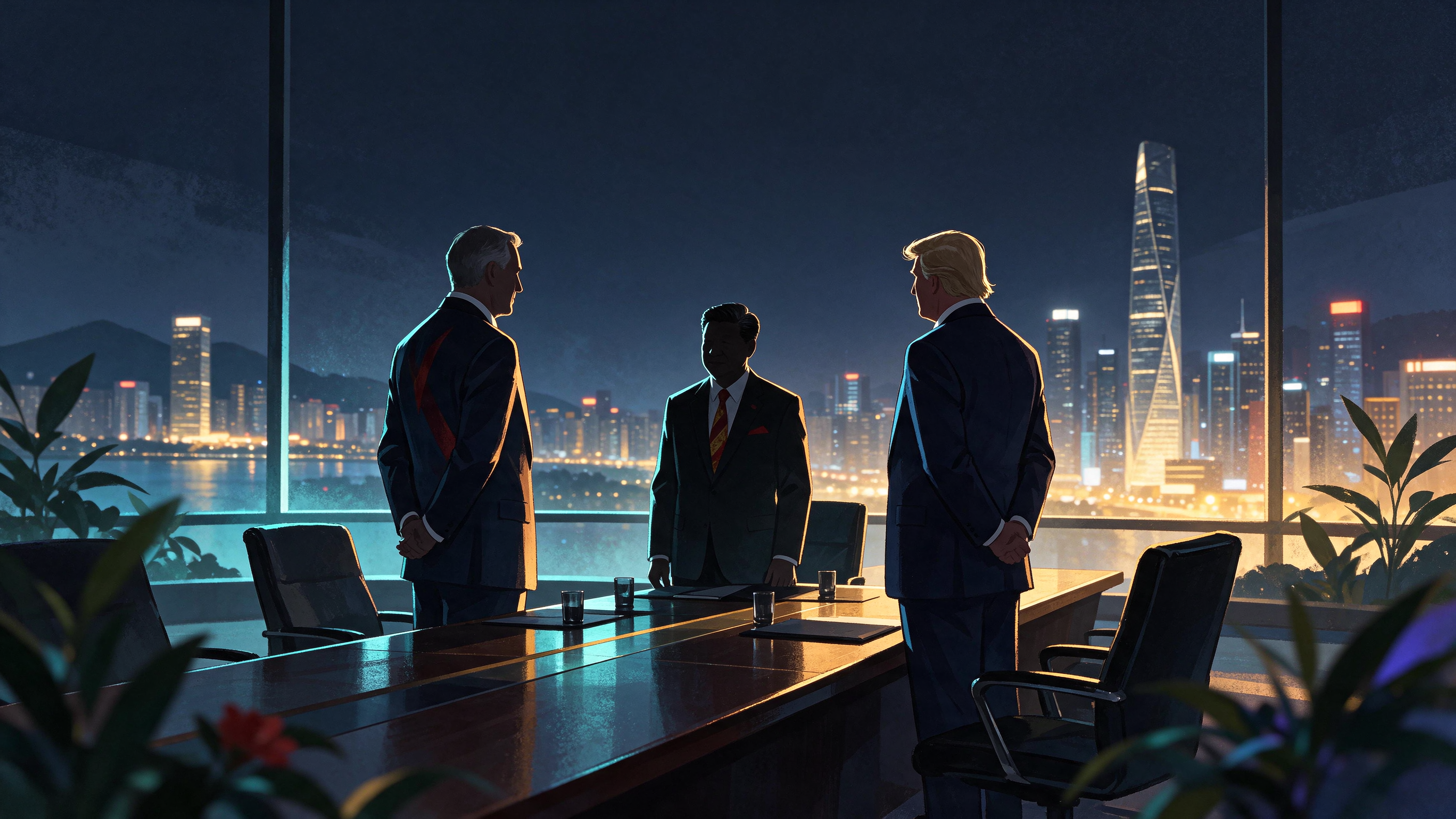
Trump, Xi and Putin are expected to hold their first trilateral meeting in Shenzhen on November 19, 2026. The meeting is significant, but its outcome is not predetermined. The most important question is whether the gathering produces practical agreements or mainly serves as a display of great-power coordination.
As of November 18, the confirmed picture is that U.S. President Donald Trump has arrived in China for the Asia-Pacific Economic Cooperation summit, Chinese President Xi Jinping has welcomed him, and Russian President Vladimir Putin is also in Shenzhen. Reuters and the Associated Press report that a trilateral meeting is planned for Thursday. The agenda is expected to include Ukraine, Iran, trade, artificial intelligence, and nuclear risk, but a final agreement has not been announced.
What is confirmed
- Trump arrived in Shenzhen on November 18 for the APEC summit, according to the Associated Press report carried by NPR.
- Xi personally greeted Trump at the airport. Reuters described the gesture as an unusual act of diplomatic reciprocity.
- Putin is also attending the summit. Reuters reported that the three leaders are expected to meet on the sidelines on November 19.
- The U.S. State Department’s public schedule confirms that Secretary of State Marco Rubio is travelling with Trump through the Philippines and China from November 16 to 19.
Why this meeting matters
The summit brings together the leaders of the United States, China, and Russia at a moment when several security and economic disputes overlap. Washington and Beijing are still managing tensions over advanced AI chips, tariffs, Taiwan, and supply-chain leverage. Russia’s war against Ukraine remains unresolved. In the Middle East, the United Nations says the Gulf remains fragile and that shipping through the Strait of Hormuz is substantially below pre-conflict levels.

Three issues to watch
1. Ukraine and the limits of personal diplomacy
Trump has said he wants to discuss ending the war in Ukraine. The AP reported that he has described a possible opening for negotiations, while analysts quoted in the same report do not expect an immediate breakthrough. The key test will be whether the leaders can move beyond broad statements and address security guarantees, territory, sanctions, and the role of Ukraine and European governments. Any settlement discussed without the parties directly affected would face a serious legitimacy problem.
2. Trade and technology competition
Reuters reported that Xi used his APEC address to defend free and open trade, while Washington has announced further restrictions intended to limit China’s access to advanced AI chips. That combination makes technology a security issue as well as a commercial one. A limited understanding on export controls or supply chains could reduce short-term tension, but a larger strategic settlement would require concessions that neither side has publicly signalled.
3. Nuclear and regional security
The AP reported that nuclear weapons are among the subjects Trump wants to raise. The meeting could also touch on Iran, North Korea, Taiwan, and maritime security. These issues are connected by a common risk: a local crisis can become a wider confrontation when military signalling, sanctions, and alliance commitments overlap. The most credible result would therefore be practical crisis-management channels, not a sweeping claim that the global order has been remade.
What would count as a meaningful result?
A meaningful result would be specific and verifiable. Examples could include a follow-up negotiating channel on Ukraine, an agreed military-communication mechanism, a clear commitment to avoid dangerous incidents at sea or in the air, or a defined process for discussing AI and strategic stability. A joint photograph and general language about peace would be diplomatically important, but they would not by themselves show that the underlying disputes had been resolved.
The wider global-order question
The summit is already drawing comparisons with historical great-power conferences. That comparison should be treated carefully. Smaller states and the countries directly involved in conflicts will judge the meeting by whether their interests are included, not by the symbolism of the leaders’ encounter. If the three powers present themselves as deciding the future of regions without broader participation, the meeting could increase anxiety even while producing temporary diplomatic momentum.
For now, the safest conclusion is that the meeting is an opportunity, not a settlement. The practical details released after the talks—especially on Ukraine, arms control, technology restrictions, and regional crisis channels—will show whether Shenzhen becomes a working forum or mainly a high-profile demonstration of personal diplomacy.
Sources
- Reuters: Xi, Putin blast Western protectionism and sanctions as Trump lands in China
- Associated Press via NPR: Trump lands in China with key meetings with Xi and Putin on the agenda
- U.S. Department of State: Public Schedule, November 18, 2026
- United Nations News: Security Council update on Gulf security and Strait of Hormuz shipping
Editorial note: The article reflects information available before the expected November 19 meeting. It will not be treated as a report of an agreement unless an official statement confirms one.

Leave a Reply