
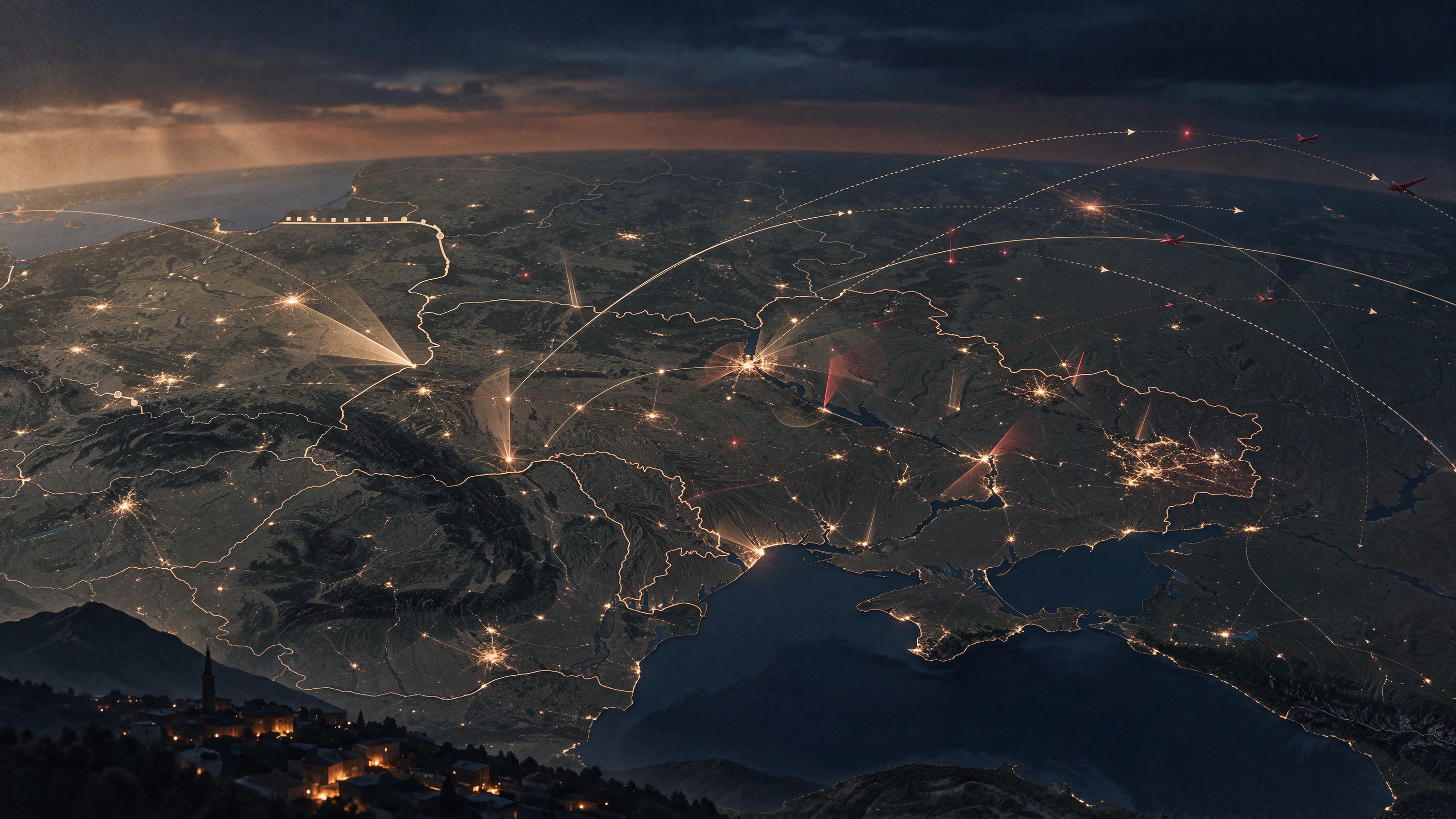
Russia launched one of the largest reported missile-and-drone attacks of the war on Ukraine on November 20, killing at least eight people and damaging energy and transport infrastructure. Poland says three objects—probably two missiles and a jet-powered drone—entered its airspace during the attack. The immediate danger is not an automatic NATO-Russia war, but a widening cycle of retaliation and miscalculation.

What is confirmed
Reuters reported that Russia struck Kyiv and other Ukrainian regions overnight with missiles and drones, hitting electricity facilities and transport infrastructure. Ukrainian officials cited by Reuters said more than 400 drones and more than 110 missiles were launched, including ballistic missiles. Ukraine’s air force said it had downed 380 drones, 79 cruise missiles and three ballistic missiles. Those figures are claims from the parties to the war and cannot be independently verified in full.
Reuters reported eight deaths: six in Kyiv and two at a railway station in Lviv. It also reported injuries in several regions, damage to railway infrastructure, emergency power outages and disruptions affecting water pressure in parts of Kyiv. Reuters noted that it could not independently confirm every casualty and damage report.
Russia’s Defence Ministry said its forces hit defence-industry facilities, energy and transport infrastructure, road and rail bridges in Kyiv, port facilities near Odesa and vessels it described as supporting Ukraine’s military. Those are Russia’s stated targets and claims, not independently established facts.
The Poland connection
Polish Defence Minister Władysław Kosiniak-Kamysz said that Polish airspace was violated by three objects from Russia: a Kh-101 cruise missile, another object believed to be a missile, and a jet-powered drone. Prime Minister Donald Tusk called the incident an apparent intentional provocation, while Poland said investigations were continuing at several locations. These statements are reported by Reuters; the final identification and circumstances remain subject to investigation.
The distinction matters. A reported airspace violation is serious, but it does not by itself establish that Moscow intended to attack Poland or that NATO’s collective-defence clause has been activated. Warsaw’s immediate response has been to investigate, continue planned military exercises and seek stronger support for the alliance’s eastern flank. NATO Secretary General Mark Rutte was due to visit Warsaw, according to Reuters.

Timeline
- November 19: President Vladimir Putin said Russia would retaliate after Ukrainian attacks on the bridge linking occupied Crimea with Russia’s Krasnodar region, according to Reuters.
- Overnight into November 20: Russia launched a large combined missile-and-drone attack across Ukraine. Kyiv residents sheltered in the metro as explosions were reported around the capital.
- November 20: Ukrainian authorities reported deaths, infrastructure damage and emergency power measures. Poland reported objects entering its airspace and began investigations.
- Next step: Poland is seeking additional eastern-flank support and is coordinating with allies while the identity and trajectory of the objects are examined.
Why the escalation risk is rising
The attack shows how the war is increasingly targeting systems that connect the battlefield to civilian life: electricity, bridges, railways, ports and water services. Russia says it is striking military logistics and defence production. Ukraine says its infrastructure is being attacked in a way that imposes costs on the civilian population. Both descriptions can coexist in the same battlespace, but neither removes the need to distinguish military claims from independently verified damage.
The reported Polish incursions add a second danger. When weapons cross an alliance border, even unintentionally, governments have less time to determine whether an incident is navigation error, spillover, deliberate signalling or a test of allied response. That shortens the space for diplomacy. It also increases pressure on Poland and NATO to show that the border is defended without taking steps that could widen the war.
What to watch next
The most important indicators will be the Polish investigation, any formal NATO assessment, the scale and duration of Ukraine’s power and transport disruptions, and whether Russia follows the reported barrage with additional attacks. A second question is whether Ukraine and its partners can strengthen air defence quickly enough to protect energy infrastructure during the next phase of the war.
Diplomatically, the incident arrives just after the Berlin meeting of the Coalition of the Willing, where Ukraine and European partners discussed air defence, security guarantees and support for negotiations. The official Ukrainian statement records the coalition’s focus on security and diplomatic coordination. The contrast is stark: negotiations require time and confidence, while large attacks and cross-border incidents create pressure for immediate retaliation.
For broader context, see our analysis of the previous day’s great-power summit, Trump, Xi and Putin’s Shenzhen Summit: A Declaration, Not a Breakthrough. That meeting emphasized strategic stability; the latest attacks show how quickly the security environment can move in the opposite direction.
Sources and verification
- Reuters: Eight killed in Ukraine as Russia hits back after Crimea bridge attacks
- Reuters: Russia says it hits sea vessels, energy and transport facilities in Ukraine
- Reuters: Poland condemns Russian provocation after three airspace violations
- Official website of the President of Ukraine: Joint statement by the leaders of Germany, France, the United Kingdom and Ukraine
Editorial note: The images in this article are original illustrative artwork. They are not documentary photographs and do not depict unverified scenes as fact.

Leave a Reply