
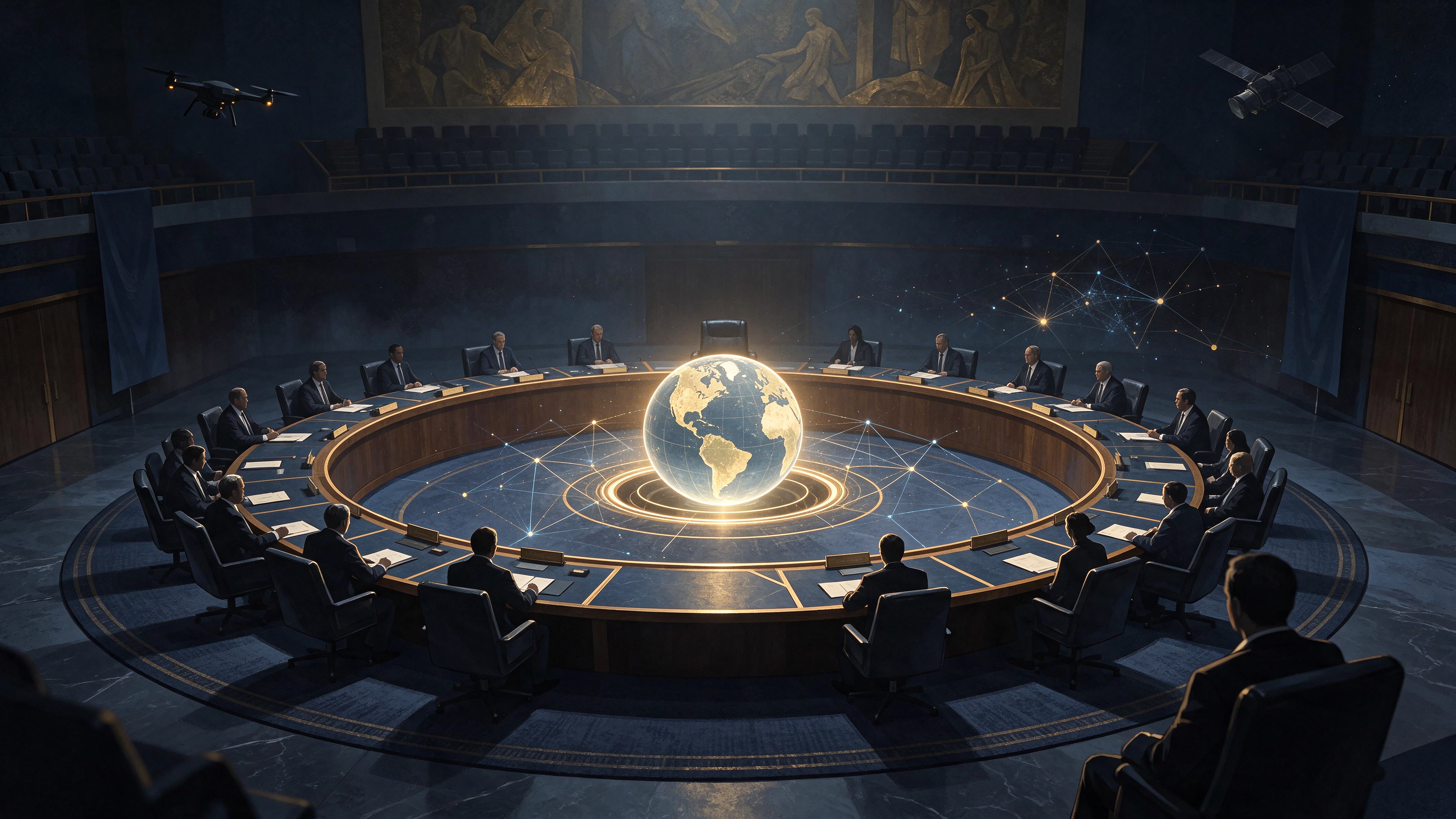
Direct answer: The United Nations Security Council’s 24 November 2026 debate is a meaningful test of whether diplomacy can adapt to technologies that are already changing warfare and information systems. It is not, by itself, a new binding agreement on artificial intelligence or autonomous weapons. Its significance lies in whether Council members can turn broad concern into practical rules, better early warning, stronger civilian protection and clearer human responsibility.

What is happening today?
Latvia, which holds the Security Council presidency for November, has scheduled a high-level open debate at 10:00 a.m. New York time on “Maintenance of international peace and security: conflict resolution in an era of rapid technological change.” Latvia’s official concept note says the meeting will examine emerging technologies across the conflict-management cycle, from early warning and prevention to mediation, peacekeeping and post-conflict recovery.
UN Secretary-General António Guterres is expected to brief the meeting, alongside representatives of the International Peace Institute, the International Committee of the Red Cross and Microsoft. The format matters because it brings political, humanitarian and technology perspectives into the same discussion. But a debate is still a debate: unless members adopt a resolution, presidential statement or other agreed outcome, the meeting will not create new binding obligations.
What the UN says technology is changing
Latvia’s concept note identifies several developments that are already affecting international peace and security. It says AI systems are assisting with targeting, drones are reshaping the physical battlefield and digital ecosystems are being used to spread disinformation. It also points to the growing difficulty of governing advanced technologies that can spread globally within months rather than decades.
Those points should be read carefully. The document is an official agenda-setting paper, not an independent audit of every battlefield claim. It describes the policy problem the Council wants to discuss. It does not prove that every alleged use of AI or every online influence campaign has been independently established in each conflict.
The concept note also stresses that international humanitarian law continues to apply regardless of the tools used. In practical terms, new technology does not remove the duties to distinguish civilians from military targets, take precautions, investigate alleged violations or maintain accountability for decisions.
Why this is more than a technology discussion
The central issue is political control. A faster sensor, an autonomous system or an AI-generated information campaign can shorten the time between warning, decision and harm. That can make diplomacy more difficult because mediators may have less time to verify an incident, correct false information or prevent retaliation.
At the same time, technology can help diplomacy. Better data collection and analysis may improve early warning. Remote sensing can support monitoring. Translation and pattern analysis can help mediators identify changes in conflict dynamics. Digital tools can also help peacekeeping missions understand threats and protect personnel.
The danger is that capability can advance faster than oversight. If decision-makers rely on opaque models, manipulated data or unverified online material, a tool designed to improve situational awareness can instead accelerate miscalculation. That is why the concept note places information integrity, civilian protection and meaningful human oversight alongside innovation.

What to watch in the debate
Four questions will show whether the discussion is moving beyond general statements.
- Human control: Will members define what meaningful human oversight requires before, during and after an AI-assisted decision?
- Civilian protection: Will protection be treated as a design requirement, rather than a review conducted only after people are harmed?
- Evidence and information integrity: Will the Council address synthetic media, manipulated evidence and the verification burden facing mediators and peacekeepers?
- Implementation: Will the UN receive expertise, training and resources, or will the debate remain a high-level expression of concern?
How this connects to the autonomous-weapons debate
The meeting follows the recent UN discussions on lethal autonomous weapons, where governments reached a two-year compromise without binding rules. That earlier result showed the gap between the urgency of the technology and the difficulty of securing common legal language. The new debate widens the lens: it asks not only whether weapons should be autonomous, but how technology affects the entire path from early warning to peacebuilding.
For background, see our analysis of the UN killer-robot talks and their two-year compromise. The distinction is important. Autonomous-weapons negotiations focus on weapons and human control, while today’s Security Council debate also covers mediation, peacekeeping, disinformation and civilian protection.
What it means for India and the wider region
India is not a permanent Council member in the current debate, but the issues are directly relevant to its security environment. Drones, cyber operations, satellite imagery and AI-assisted information campaigns affect South Asian crisis management as much as they affect conflicts elsewhere. India’s diplomats and security institutions will have to balance the benefits of new capabilities with the risks of escalation, attribution errors and civilian harm.
For countries outside the permanent-member group, the practical question is whether future rules will be shaped only by the states with the largest military and technology industries. A credible UN process should give developing countries access to technical expertise and a meaningful role in defining safeguards, not simply ask them to accept standards written elsewhere.
What is fact, what is uncertain, and what is analysis?
Confirmed: the Security Council has scheduled the high-level open debate for 24 November; Latvia circulated the concept note; and the listed theme covers conflict resolution in an era of rapid technological change.
Attributed claims: the descriptions of AI-assisted targeting, drones and disinformation come from Latvia’s official concept note. Reuters has separately reported that Iran–US diplomacy remains active but that the two sides remain far apart on acceptable terms, illustrating the wider pressure on diplomacy in a technology- and conflict-heavy international environment.
Uncertainty: the debate’s final political outcome, any agreed text and the practical commitments of individual governments are not known at the time of publication. Claims about specific battlefield systems also require conflict-by-conflict verification.
Analysis: the meeting will matter if it links technology policy to operational decisions—verification, civilian protection, training, accountability and resources. A carefully worded statement without implementation would be useful as diplomacy, but insufficient as governance.
Frequently asked questions
Is the UN creating a new AI treaty today?
No. The scheduled meeting is a high-level open debate. It may influence future policy, but the agenda itself does not create a new treaty or binding AI rules.
Does AI replace human decision-making in UN peacekeeping?
No. The concept note discusses technology as a tool for analysis, early warning and operational support while emphasizing meaningful human oversight and continuing legal responsibility.
Why does the debate matter if no binding decision is expected?
Security Council debates can shape the language, priorities and institutional work that follow. They also reveal whether governments agree on practical safeguards or only on broad principles.
What should readers watch after the meeting?
Look for the meeting record, any presidential statement or agreed outcome, concrete proposals on civilian protection and information integrity, and evidence that the UN will receive the expertise and resources needed to apply them.
Sources
- United Nations Security Council document S/2026/889 and Latvia’s concept note.
- UN Security Council provisional programme of work.
- Security Council Report: Conflict Resolution and Emerging Technologies.
- Reuters: Iran says diplomacy remains the preferred route while the US rejects unacceptable terms.
This analysis distinguishes scheduled facts, attributed positions, uncertainty and interpretation. It will be updated if the Security Council produces a substantive outcome after the debate.

Leave a Reply