
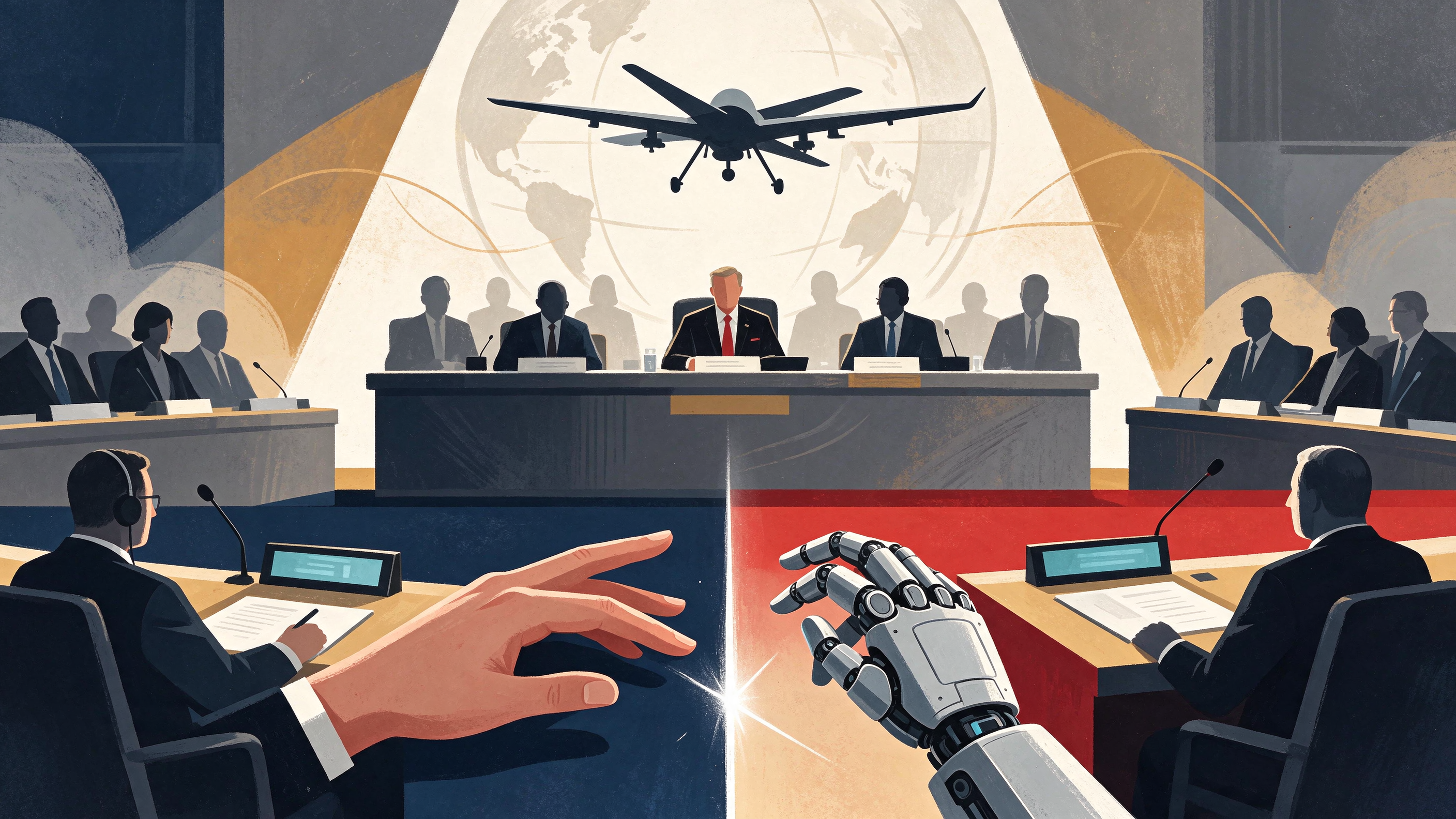
The United Nations’ latest attempt to build guardrails around lethal autonomous weapons has ended with a compromise that creates a negotiating timetable, not a legal settlement. Delegates meeting in Geneva agreed to continue work toward a possible 2028 accord, but they did not commit to binding rules. That distinction is the central fact of the outcome.

What was agreed — and what was not
The talks took place under the Convention on Certain Conventional Weapons, the framework used by states to discuss weapons that raise humanitarian and security concerns. The convention has 128 High Contracting Parties. At the review conference, UN Secretary-General António Guterres called for a legally binding instrument with clear prohibitions and restrictions on autonomous weapons. The UN’s account of his appeal made the gap between the political ambition and the negotiating result clear.
The final compromise extends discussions for another two years and points toward a possible accord by 2028. Reporting by NPR and the Associated Press says states did not make a firm commitment to binding rules. The options left open include a legally binding instrument or voluntary guidance. In practical terms, the conference produced a process for negotiation rather than a prohibition, treaty or operational standard.
Timeline of the Geneva outcome
16 November: The review conference opened in Geneva under the Convention on Certain Conventional Weapons. The debate focused on systems that can select and engage targets with limited or no human intervention at the moment of attack.
During the conference: Guterres urged states to negotiate a legally binding instrument. Humanitarian organizations pressed for meaningful human control, accountability and limits on systems whose behavior may be difficult to predict or attribute.
21 November: Delegates settled on a two-year continuation of the talks and a possible 2028 outcome. The language leaves the legal form of that outcome unresolved. Because the process works by consensus, a single government can prevent agreement on stronger rules.
Why the compromise matters
The immediate benefit is that diplomacy remains alive. A two-year mandate gives governments time to narrow disagreements over definitions, human control, accountability and the distinction between autonomous functions and ordinary automation. It also keeps the issue inside an established multilateral forum rather than pushing each military power toward separate national standards.

The risk is that the timetable becomes a substitute for regulation. NPR’s reporting from Geneva describes a process in which negotiators are still debating whether the eventual result should be binding or optional, while humanitarian groups warn that military AI may advance faster than international law. If deployment, testing and procurement continue during the negotiating window, the facts on the ground could make a later agreement harder to enforce.
The accountability problem
The hardest question is not whether software can assist a weapon. Modern militaries already use algorithms for sensing, navigation, prioritization and decision support. The more difficult issue is where responsibility sits when a system selects a target or determines the timing and method of an attack in circumstances that change faster than a human can meaningfully intervene.
A credible future agreement would therefore need more than broad language about responsible innovation. It would need workable limits on unacceptable autonomous functions, a defensible standard for human control, testing and review obligations, and a clear chain of responsibility when systems fail. Whether those provisions are legally binding or politically voluntary will determine how much protection the eventual framework offers.
A wider geopolitical test
The negotiations also test whether consensus diplomacy can keep pace with strategic competition. States that see autonomous systems as a way to offset manpower or reduce risk to their own forces may resist limits that they regard as unilateral constraints. Other governments and humanitarian organizations see the same systems as a challenge to civilian protection and the laws of war. The result is a familiar security dilemma: each side fears that restraint could leave it behind.
That tension is visible across today’s broader security environment. The outcome should be read alongside, not separately from, the escalation risks discussed in the latest Ukraine and Poland analysis and the strategic signaling examined in the assessment of the Trump–Xi–Putin Shenzhen summit. In each case, technology, military posture and diplomacy are moving on different clocks.
The bottom line
Geneva did not produce a ban, a treaty or binding rules for lethal autonomous weapons. It produced two more years of negotiations and a possible 2028 decision point. That is better than a collapse of the process, but it is not the legal protection many governments, UN officials and humanitarian advocates sought.
The measure of success will not be whether diplomats can announce another mandate. It will be whether the next phase converts general concern into specific limits that preserve human responsibility before autonomous targeting becomes too widespread, opaque or strategically valuable for governments to constrain.

Leave a Reply